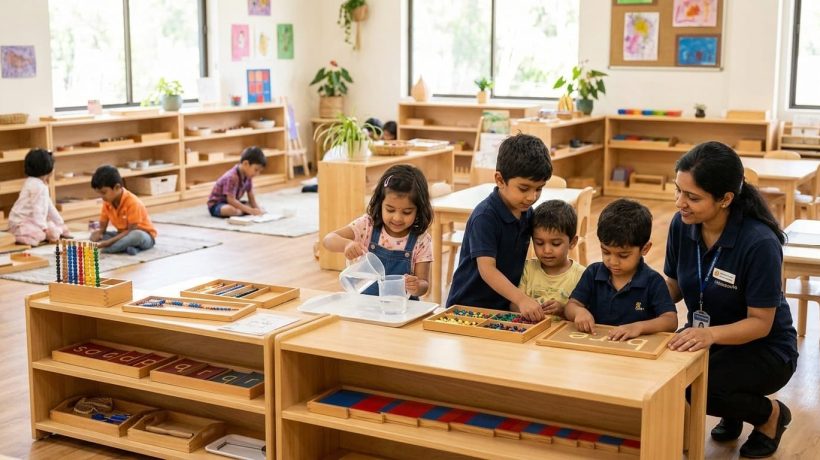
Walk into a Montessori classroom, and you will observe something surprising. There’s no loud lecturing, no rows of desks facing the blackboard, and no rush to finish the syllabus.
Instead, you will find children enjoying and deeply absorbed in hands-on activities and learning experiences, including pouring, sorting, counting beads, tracing letters, helping a friend, or quietly concentrating on a puzzle.
This is the Montessori difference!
For many parents today, education is not just about chasing marks and milestones anymore. It’s about nurturing confident thinkers, compassionate individuals, and independent learners. This shift in perspective is why Montessori education continues to gain attention worldwide.
At Chitrakoota, the Montessori approach is not just a classroom format; it’s a philosophy of how little learners grow, explore, and understand the world around themselves. But how exactly does it differ from traditional education methodologies? Let’s dive into it!
Before jumping into how the Montessori method differs from traditional teaching methods, let’s decode the exact Montessori education meaning.
Montessori education is a child-centric education approach developed by Dr. Maria Montessori. Also known as the Maria Montessori education system, it is built on a simple yet powerful belief that children learn best when they are actively involved in their own learning.
Instead of passive listening, the Montessori classroom environment encourages:
Children are not rushed, not compared, but rather guided by Montessori teachers to learn at their own pace. Montessori pre-school education supports learning that feels purposeful, joyful, and deeply rooted in understanding, not rote memorization.
A clear understanding of the key differences between Montessori and traditional schools is essential for parents to make a confident decision for their child’s schooling.
The traditional education system mostly follows a structured, teacher-led method of education where the teacher explains, students listen, and everyone in the classroom is expected to keep up with the same lesson at the same pace. Exams and grades decide how well students are doing.
Montessori philosophy flips the approach. Here, kids take the lead by learning things at their own pace. The Montessori education focuses on mastery of concepts rather than chasing marks. Here, independence matters as much as academics. The main difference between Montessori and traditional education lies in the teaching style.
In a traditional classroom, the teacher directs the learning, and all the students are expected to follow the same instructions at the same time.
At Chitrakoota’s Montessori classroom, the dynamic shifts. Here, teachers act as guides and observers, carefully understanding each child’s interests, readiness, and learning style. Lessons are introduced individually or in small groups. Kids pick meaningful Montessori activities within a well-organized environment.
The Montessori approach to education helps children build confidence, enhance decision-making skills, and really get involved in what they are doing. Instead of asking toddlers, “Did you finish what was assigned?” the focus shifts to “What did you discover today?”
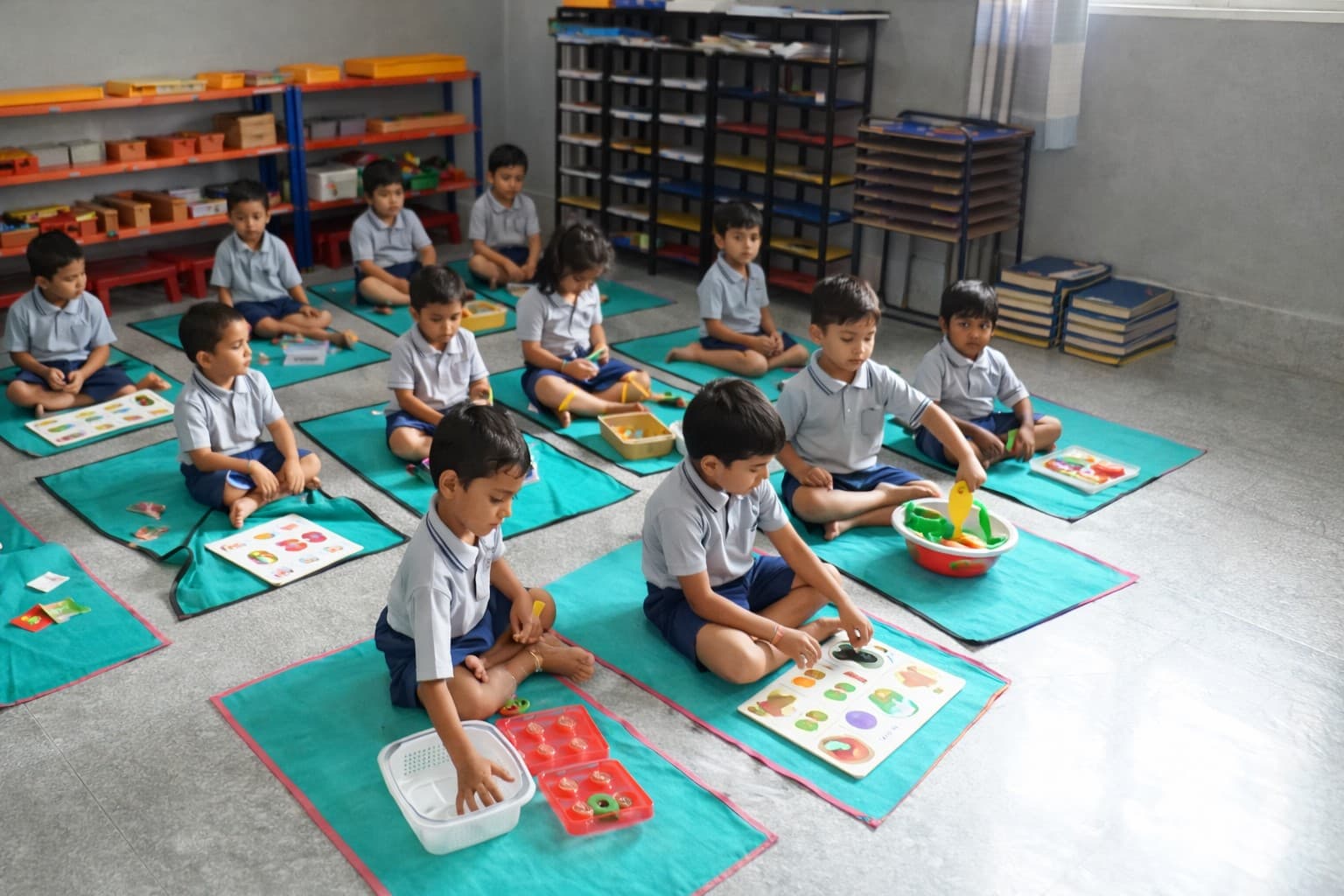
Unlike traditional classrooms, kids are not meant to sit straight for long periods absorbing information passively. Montessori classrooms are thoughtfully prepared with learning materials. Children build, sort, count, measure, explore language, and solve problems using concrete tools.
Montessori material at Chitrakoota is tactile, precise, and self-correcting. It allows children to learn things practically in their own style, which ultimately builds confidence and problem-solving skills. Mathematics is not just numbers on a worksheet here. It’s beads, rods, and visual representations. And language? It goes beyond a spelling list; it’s a phonetic discovery and storytelling.
These hands-on learning activities, where children use their hands and minds together, ensure that concepts are understood deeply and retained longer. In contrast, the traditional approach relies heavily on textbooks, note-taking, and repetition. While memorization helps students for tests, experiential learning prepares them for life.
One of the crucial differences between a Montessori school vs traditional school is the teaching process. The traditional method follows a uniform timeline. If a child struggles, they may feel left behind. And if they grasp concepts quickly, they may feel unchallenged.
The Montessori method encourages developmental readiness. At Chitrakoota School, children move forward when they are truly ready. They revisit lessons till they achieve mastery. When it comes to Montessori learning, there is no race, no comparison, and no pressure to keep up with anyone else.
The result? The learners who feel capable and not anxious.
Traditional schools generally group children by age. In a Montessori classroom, things look really different. Here, children of different ages learn and explore things together. This creates a natural learning community. Young children observe and learn from older peers. Older children step up, helping out and explaining things, which actually deepens their own understanding.
At Chitrakoota Montessori, this mixed-age structure fosters empathy, cooperation, and a sense of belonging, qualities that cannot be taught through textbooks.
In many traditional settings, discipline is maintained through rules, rewards, and consequences. Montessori style of education encourages something deeper: self-discipline!
When kids dive into work they care about, they naturally develop focus. The Montessori way of teaching emphasizes giving freedom but with responsibility. Students learn to care for materials, respect others’ work, put things back where they belong, and manage their learning time.
This is not the discipline imposed from outside. It is the discipline that grows from within and stays with them far beyond the classroom.
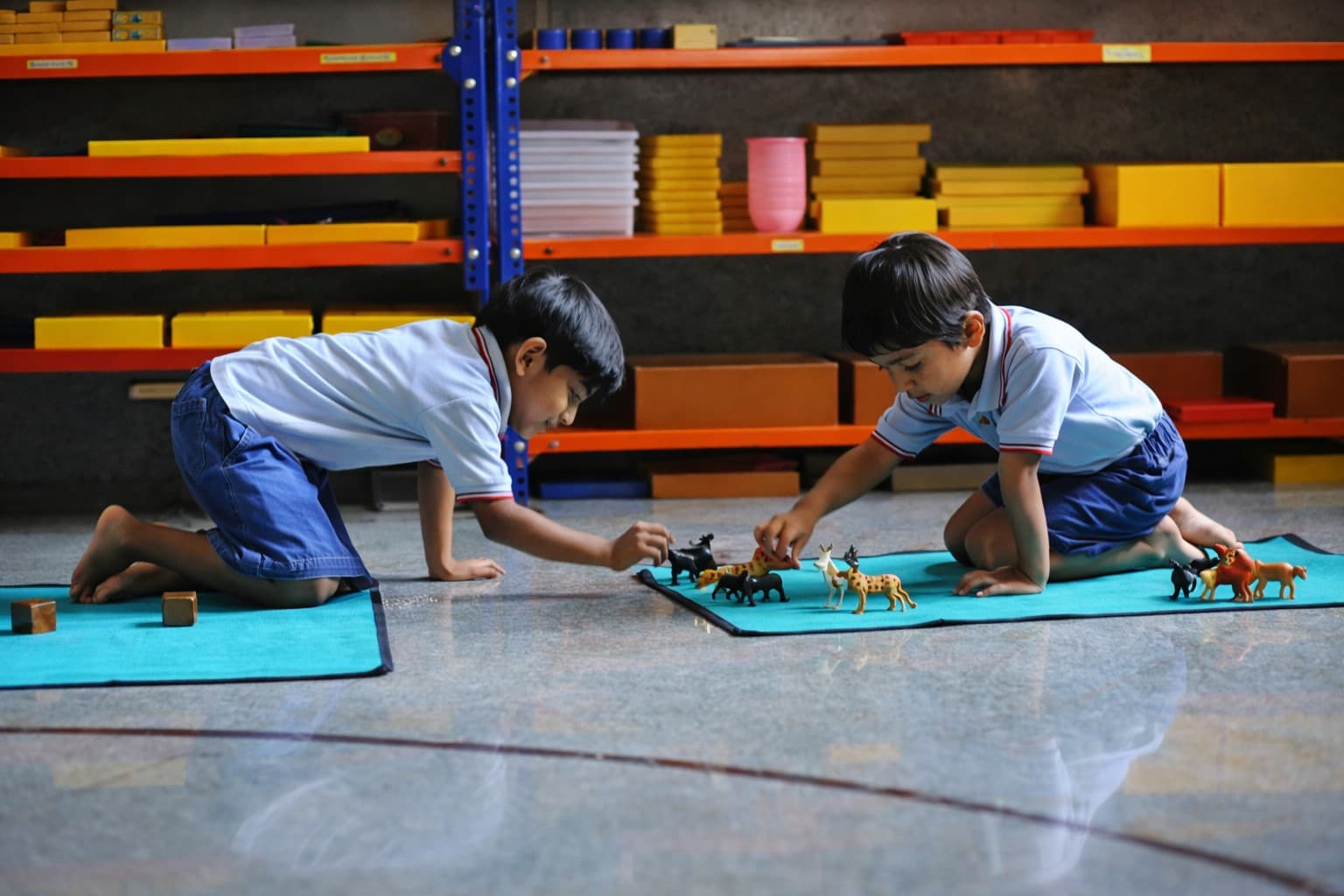
Education is not just about good grades or test scores. The Montessori school focuses equally on emotional intelligence, social skills, practical life abilities, and cognitive development, and this is what makes them different from traditional schools.
Sure, reading, writing, and math matter. But so does learning how to tie your shoes, share snacks, collaborate with peers, and actually share your feelings respectfully. These seemingly simple tasks build competence and self-esteem.
Unlike traditional schools, teachers in Montessori help children to learn and evolve into well-rounded individuals ready for life, not just academics. And that’s the reason why kids really enjoy their day when dropped at Chitrakoota Montessori!
Assessment technique is also a key factor to consider while choosing between Montessori and traditional schools. Traditional teachers rely on periodic exams and standardized testing to track students’ progress. Montessori students are assessed through continuous observation.
Teachers at Chitrakoota observe children’s work, concentration level, social interaction, and skill development closely. Progress is documented thoughtfully and shared with parents in a constructive and meaningful way.
Instead of cramming for tests, kids show what they know by doing, every single day. They work through ideas until they really get them. The Montessori method allows children to develop mastery by significantly reducing performance anxiety and maintaining academic standards.
And if you are planning to enroll your child in a Montessori school, don’t forget to go through this checklist for Montessori school before admission!
Walk into the Montessori classroom at Chitrakoota, and you will find an environment where the entire system of education feels different. Our classrooms are carefully prepared with child-sized furniture, organized low shelves, accessible learning materials, and calm, inviting spaces.
Children in our Montessori setting choose their work on their own, return materials independently, and take ownership of their surroundings. This environment silently teaches responsibility, order, and autonomy.
Slowly and beautifully, children begin to believe in their own capabilities. You can see their confidence grow. And this is why parents choose Chitrakoota Montessori to ensure a strong and purposeful foundation for their child that fosters lifelong love for learning naturally.
The difference between the Montessori and traditional methods is not about better or worse; it’s about the approach to education. Chitrakoota Montessori School emphasizes independence over instruction, curiosity over conformity, mastery over memorization, and growth over grades.
Montessori teaching methodology places the teacher as an associate who helps the child to learn at their own pace, preparing the child not just for the next class but for life.
Compared to traditional schools, at Chitrakoota, families find that children are not shaped to fit a system; rather, the system adapts to nurture the child.
And this is what makes this approach not just different but deeply meaningful!
The Montessori method of teaching is a child-centred educational approach that encourages hands-on exploration, self-directed learning, mixed-age classrooms, and independence within a thoughtfully prepared environment.
Most parents enroll their child in Montessori around 2.5 to 3 years old. Early childhood is an ideal stage to start Montessori because young kids are naturally curious and highly receptive to experiential learning.
Montessori education focuses on continuous observation and mastery-based assessment rather than frequent formal exams. Kids show what they have learned by actually doing things, not by cramming for tests.