Choosing the right educational approach for your child is an important decision for every parent. During the early years, children are naturally curious, active and eager to explore their surroundings. Montessori education is designed around this natural curiosity, giving children opportunities to learn through exploration, hands-on experiences and meaningful activities.
But what exactly is Montessori education? How does it work, and how is it different from conventional early education?
Let’s understand Montessori education and what parents should know before choosing this approach for their child.
Montessori education is a child-centred approach developed by Dr. Maria Montessori. It encourages children to learn through hands-on experiences, exploration and independent activity within a carefully prepared environment.
Instead of every child being expected to learn the same lesson at the same time, Montessori education recognizes that children develop at different rates. Teachers observe each child, introduce appropriate learning materials and guide them as they explore.
The objective is not simply to teach children facts. It is to help them develop independence, concentration, curiosity, confidence and a positive attitude towards learning.
At Chitrakoota, the Montessori programme follows a child-centred and experiential approach, with opportunities for children to learn through exploration and hands-on experiences.
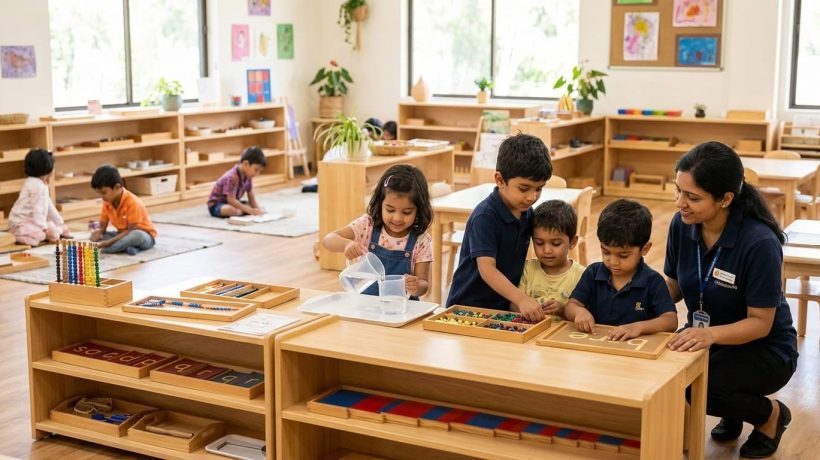
A Montessori classroom is carefully designed to encourage children to participate actively in their learning.
Children are introduced to specially designed Montessori materials that allow them to explore concepts through touch, movement, observation and repetition. They can work with materials independently while teachers observe, guide and support them when needed.
Three elements are particularly important:
Children get opportunities to make meaningful choices about their activities within a structured environment. This can help them gradually develop independence and responsibility.
Young children learn naturally through doing. Montessori materials allow them to physically explore concepts before moving towards more abstract learning.
The classroom is organized so that children can access age-appropriate materials and participate in activities independently. A purposeful environment can encourage concentration, order and confidence.
At Chitrakoota, the Montessori approach emphasizes child-led, hands-on and experiential learning as part of the early years programme.
Montessori education covers much more than reading and numbers. It supports different areas of a child’s development.
Children participate in age-appropriate activities that help develop coordination, concentration and independence. Simple tasks such as arranging, sorting, pouring or taking care of their surroundings can become meaningful learning experiences.
Children explore concepts through their senses. Montessori materials allow them to observe and compare differences in size, shape, colour, texture and other characteristics.
Language development is an important part of Montessori education. Children can develop vocabulary, listening skills, communication and early reading and writing abilities through conversations, stories and carefully designed materials.
Montessori mathematics introduces children to numbers and mathematical concepts using concrete materials. Children can explore counting, quantities, patterns and relationships before gradually moving towards abstract concepts.
Children are naturally curious about the world around them. Montessori learning can introduce age-appropriate concepts related to nature, geography, science, culture and everyday life.
Every child is different, and educational experiences can vary from one school to another. However, Montessori education is designed to support several important areas of development.
Children are given opportunities to complete age-appropriate activities and take responsibility for their learning environment.
Montessori activities often involve focused work and repetition, allowing children to develop their ability to concentrate on a task.
Rather than always being given an answer, children can explore materials, identify challenges and discover solutions through hands-on experiences.
Completing activities independently can give children a sense of achievement and encourage them to approach new challenges with confidence.
Children are naturally curious. Montessori education provides opportunities for them to explore, ask questions and discover concepts through experience.
Children learn alongside others and have opportunities to communicate, cooperate, respect their surroundings and become part of a classroom community.
Montessori education and conventional kindergarten can have different approaches to learning.
In a more traditional classroom, the teacher may lead the entire group through the same lesson or activity at a particular time. Montessori education generally gives children more opportunities for independent exploration and hands-on work within a prepared environment.
The role of the teacher is also different. Montessori educators observe children, introduce appropriate materials and guide them rather than continuously directing every activity.
However, every school implements its educational approach differently. Parents should therefore understand how Montessori principles are actually practised in a particular school rather than relying only on the label “Montessori.”
Choosing a Montessori school involves looking beyond the classroom and understanding the learning experience.
Parents can consider questions such as:
A school visit can also help parents understand the classroom environment, teaching approach and interaction between educators and children.
Chitrakoota has offered Montessori education since 2004. Its Montessori programme is designed for children in the early years and follows a connected curriculum for approximately ages 2 to 6.
The school’s approach emphasizes child-led, hands-on and experiential learning, giving children opportunities to explore, make choices and develop independence.
Chitrakoota also incorporates creative experiences into its Montessori programme. Events such as Chinnara Chilipili give children opportunities to participate in activities such as singing, storytelling, skits and fancy dress.
The Montessori programme is also connected to the school’s subsequent CBSE education pathway, with children completing M3 able to transition to Chitrakoota CBSE School for Class 1 onwards.
Montessori programmes can differ in their age structure. At Chitrakoota, the Montessori programme covers the early childhood years, beginning from approximately two years of age.
Not necessarily. Montessori education generally emphasizes hands-on learning, independent exploration and a prepared environment, while conventional kindergarten may use a more teacher-directed approach.
Yes. Montessori education includes language and mathematics along with practical life, sensorial and cultural learning.
Children have different needs and personalities. Parents should understand the Montessori approach and visit the school to determine whether its learning environment is suitable for their child.
Montessori education offers children an opportunity to learn through exploration, hands-on experiences and meaningful activities. By encouraging independence, concentration, curiosity and confidence, it can provide a strong foundation for the early years of a child’s educational journey.
For parents, the key is to look beyond the name “Montessori” and understand how the approach is implemented in the classroom.
When children are given the opportunity to explore, discover and learn at their own pace within a supportive environment, education can become more than acquiring knowledge—it can become a joyful process of discovery.